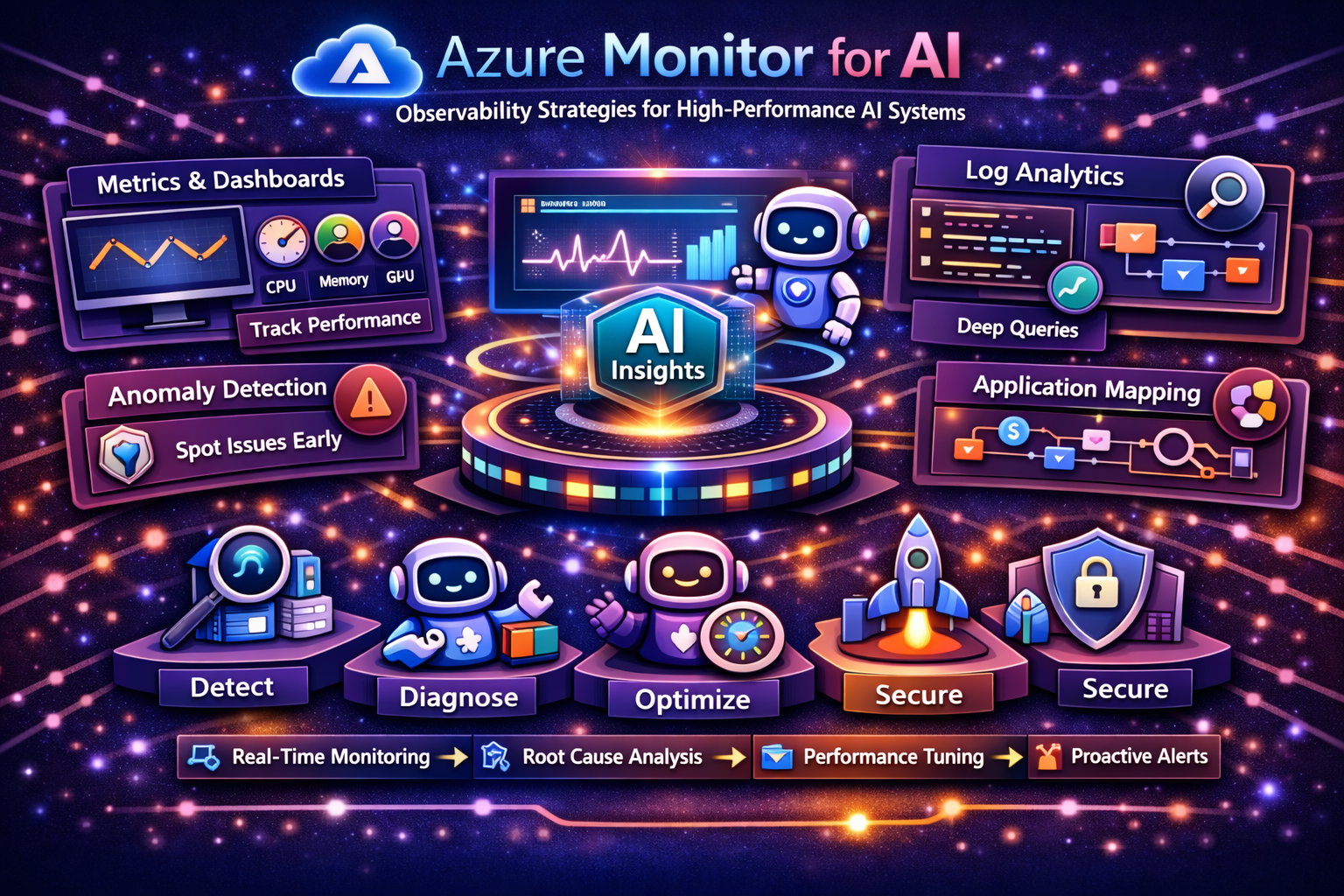
Understanding Azure Monitor for AI
Azure Monitor is Microsoft Azure’s unified monitoring platform for collecting, analyzing, visualizing, and acting on telemetry from applications, infrastructure, services, and custom workloads. In the context of AI, its role is expanding because intelligent systems create a broader and more complex observability challenge than traditional software. AI applications depend not only on application performance, but also on model behavior, orchestration quality, prompt flow execution, retrieval relevance, tool usage, safety outcomes, and operational efficiency across multiple connected components.
Azure Monitor for AI therefore represents more than technical monitoring. It is the use of Azure Monitor, Application Insights, Azure Monitor Logs, alerts, workbooks, dashboards, and related observability patterns to understand how intelligent systems behave in production. This includes everything from latency and failure analysis to distributed tracing, usage monitoring, quality tracking, and operational response.
Why Observability Matters More in AI Systems
Traditional software observability focuses on whether an application is up, responsive, and error-free. AI systems require a broader lens. A generative AI application can be available and still deliver poor results. An AI agent can complete requests but do so too slowly, too expensively, or with inconsistent quality. A retrieval-based system can remain operational while grounding responses on irrelevant content. In other words, AI success depends on more than system health alone.
Azure Monitor matters because it helps organizations move from simple uptime monitoring to a more complete observability strategy for intelligent workloads. It provides the telemetry foundation for understanding how AI systems perform technically and how they behave functionally in real use. This is essential for production AI because reliability, user trust, and business value all depend on being able to see what the system is doing and why.
Core Capabilities of Azure Monitor for AI
Azure Monitor includes several capabilities that are especially important for modern AI and machine learning workloads.
-Application Insights: Provides application performance monitoring for AI-enabled applications, APIs, and intelligent services, including telemetry collection, traces, requests, dependencies, failures, and performance analysis.
-Azure Monitor Logs: Supports centralized log analysis using Kusto Query Language so teams can investigate AI behavior, failures, patterns, and operational anomalies in depth.
-Metrics and Alerts: Helps teams track key indicators such as latency, throughput, error rates, resource usage, and operational thresholds across AI systems and supporting infrastructure.
-Distributed Tracing: Enables visibility across multi-step AI workflows where requests move through orchestration layers, retrieval components, tools, agents, and model endpoints.
-Dashboards, Workbooks, and Grafana Integration: Supports visual analysis and operational dashboards for AI system health, usage, quality, and business metrics.
-OpenTelemetry Support: Provides a standardized and vendor-neutral way to instrument AI applications and send telemetry into Azure Monitor for analysis.
-Cross-Resource Monitoring: Helps organizations observe not only the AI application itself, but also the infrastructure and services it depends on, such as containers, databases, APIs, and compute resources.
Application Insights as the Heart of AI Observability
One of the most important parts of Azure Monitor for AI is Application Insights. It serves as the application performance monitoring layer that helps teams understand requests, dependencies, traces, failures, response times, and user interactions across AI-enabled applications. In practice, this makes it possible to see how an AI system behaves under real load and where issues appear across the request lifecycle.
For intelligent applications, Application Insights becomes especially valuable because AI behavior is often distributed across several moving parts. A single user request may involve an application front end, an orchestration layer, a retrieval call, a model invocation, tool execution, and downstream APIs. Without application-level observability, diagnosing slow performance or poor outcomes becomes extremely difficult. Application Insights helps bring those layers into a more unified operational view.
OpenTelemetry and Modern Instrumentation for AI
Modern AI systems benefit from observability when telemetry is collected in a consistent and portable way. Azure Monitor supports this through OpenTelemetry-based instrumentation, which is increasingly important for code-based AI applications, APIs, and agentic systems. OpenTelemetry gives teams a standardized approach for emitting traces, metrics, and logs across different frameworks and environments.
This matters because AI architectures are rarely monolithic. Organizations may use Azure-hosted services, containerized apps, orchestration frameworks, and custom APIs in the same solution. OpenTelemetry makes it easier to instrument these components in a unified way, while Azure Monitor provides the analysis and operational layer where that telemetry becomes useful for troubleshooting, optimization, and monitoring.
Tracing AI Workflows and Agent Behavior
AI systems often involve complex, multi-step workflows that are difficult to understand without tracing. A generative AI request may include prompt preparation, retrieval, ranking, model inference, tool calls, and output generation. An AI agent may also perform actions, interact with other services, and move through several internal decisions before returning a result. Observability must therefore support more than logs. It must capture the flow of execution.
Azure Monitor helps address this challenge through distributed tracing and Application Insights experiences that support AI agents and modern intelligent workflows. This allows teams to inspect how requests move through the system, where bottlenecks appear, and which components influence the final outcome. Tracing is especially important in agentic architectures because failures may not occur in a single model call, but in the interaction between several coordinated steps.
Monitoring AI Agents with Application Insights
As AI agents become more common in enterprise architectures, observability must evolve with them. Azure Monitor Application Insights now supports an Agent details experience that helps organizations monitor AI agents across multiple sources, including Microsoft Foundry, Copilot Studio, and third-party agents. This creates a more unified operational view for teams that need to track agent performance and troubleshoot behavior in production.
This is important because agents introduce new observability requirements. Teams need to understand not only whether an agent responded, but also how it used tools, how long it took, what kinds of failures occurred, how much usage it generated, and where optimization is needed. Agent observability helps turn AI agents from experimental systems into manageable enterprise services.
Performance, Quality, Safety, and Cost as AI Metrics
High-performance AI systems cannot be evaluated with infrastructure metrics alone. CPU usage and request rates still matter, but organizations also need to observe model latency, response quality, safety outcomes, tool behavior, cost drivers, and user experience. In AI systems, a technically healthy service can still create business problems if responses are low quality, safety signals degrade, or cost scales faster than expected.
Azure Monitor supports a more complete observability model by giving teams the telemetry foundation needed to track these broader signals. When used well, this allows organizations to build dashboards and alerts that reflect what actually matters to AI operations: performance, trust, efficiency, and outcome quality together rather than in isolation.
Azure Monitor and Generative AI Observability
Generative AI introduces observability challenges that differ from those of traditional applications. Teams need to monitor prompts, completions, latency, token usage, orchestration behavior, grounding steps, and quality regressions over time. They also need to understand how AI output is affected by changes in prompts, retrieved context, tools, or upstream data. This is where Azure Monitor becomes especially strategic.
In modern Azure AI architectures, Azure Monitor helps organizations instrument generative applications so they can observe production traffic, identify slow or failing paths, correlate system behavior with user experience, and improve quality continuously. It is not only a troubleshooting tool. It is part of how organizations learn from real AI usage and refine systems after deployment.
Azure AI Foundry Observability and Azure Monitor
Azure Monitor also plays an important role in Microsoft Foundry observability. Foundry observability is integrated with Azure Monitor Application Insights, allowing teams to gain real-time insight into AI performance, safety, and quality. This creates a stronger operational bridge between application telemetry and AI-specific evaluation needs.
For enterprises using Foundry-managed projects, agents, or workflows, this integration is especially valuable because it allows AI-specific observations to be tied back to a more mature observability platform. Instead of monitoring intelligent systems through separate disconnected tools, teams can analyze them in an environment that supports both traditional application monitoring and AI-oriented inspection.
Logs, KQL, and Deep Investigation
Dashboards and alerts are important, but serious AI troubleshooting often requires deeper investigation. Azure Monitor Logs, analyzed with Kusto Query Language, give teams the ability to explore telemetry in detail, correlate events across services, identify patterns, and investigate unusual behavior over time. This is especially useful when a problem is intermittent, complex, or distributed across several AI components.
In AI environments, this kind of deep analysis can reveal whether failures are caused by upstream application issues, poor retrieval, external dependency latency, model behavior changes, tool timeouts, or infrastructure bottlenecks. KQL-based analysis therefore becomes one of the most powerful tools for serious AI observability and production diagnostics.
Dashboards, Workbooks, and Visual Operational Awareness
Effective observability also depends on how insight is presented to operations teams, engineers, and business stakeholders. Azure Monitor supports this through dashboards, workbooks, and integration with Azure Managed Grafana. These visualization options help teams create operational views tailored to their AI systems, whether the focus is platform health, model latency, request volume, cost trends, or user-facing quality indicators.
This is important because different stakeholders need different perspectives. Platform engineers may focus on application health and dependencies. AI teams may focus on traces, prompt paths, and model behavior. Business leaders may care more about reliability, cost, and service quality. A strong observability strategy should serve all of these audiences in a structured way.
Alerts and Proactive Response
Observability becomes much more valuable when it moves from passive monitoring to proactive response. Azure Monitor supports alerts that allow teams to react when key thresholds are crossed, such as rising error rates, increased latency, resource exhaustion, or unusual activity patterns. In AI systems, alerting can be especially important because failures often need fast intervention before they affect trust or user experience at scale.
The most effective alerting strategies for AI are usually not limited to infrastructure health. They also include application-level indicators, agent failure patterns, dependency degradation, and signals that point to broader quality or safety regressions. Proactive observability helps teams respond before a user complaint becomes the first sign of an issue.
How Azure Monitor Fits into the Azure AI Ecosystem
Azure Monitor becomes most powerful when it is used as the observability backbone across the broader Azure AI ecosystem. It does not replace AI services or model platforms. Instead, it provides the telemetry and analysis layer that helps organizations operate those services more reliably and at greater scale.
Azure OpenAI Service: Benefits from application-side and orchestration-side monitoring when organizations need visibility into generative AI workflows and user-facing performance.
Azure AI Search: Can be monitored as part of retrieval-driven architectures where latency and dependency performance affect final response quality.
Microsoft Foundry and Foundry Agents: Integrate with Azure Monitor Application Insights to support tracing, performance analysis, and observability for AI applications and agent workflows.
Azure Machine Learning: Relies on broader monitoring patterns across training environments, endpoints, infrastructure, and production model-serving workflows.
Copilot Studio: Can emit telemetry into Azure Monitor so teams can observe operational behavior and agent usage more consistently.
Azure Infrastructure Services: Containers, virtual machines, Kubernetes, storage, and networking can all be observed through Azure Monitor as part of the full AI application stack.
Architecture Considerations for AI Observability
A strong observability architecture for AI should begin early in the solution design process. Teams should decide which telemetry must be collected, where instrumentation belongs, how traces will be correlated across components, what logs should be retained, which dashboards different teams need, and which alerts should trigger action. These decisions affect both operational maturity and long-term debugging capability.
In many enterprise environments, Azure Monitor acts as the central observability layer while applications, agents, APIs, and infrastructure emit telemetry through Application Insights, OpenTelemetry, or related instrumentation paths. This creates a more coherent view of the AI system as a whole instead of forcing teams to investigate separate components in isolation.
Best Practices for Using Azure Monitor in AI Systems
-Instrument Early: Add observability during design and development instead of waiting until production issues appear.
-Trace End-to-End Workflows: Capture the full AI request path across orchestration, retrieval, model calls, tool use, and downstream dependencies.
-Monitor More Than Availability: Include latency, quality, safety, usage, and cost-related indicators in the observability model.
-Use OpenTelemetry Where Appropriate: Standardize instrumentation across modern applications and services to improve portability and consistency.
-Build Role-Specific Dashboards: Give engineers, AI teams, and business stakeholders the views they need for effective operations.
-Alert on Meaningful Signals: Create alerts that reflect user impact and AI system health rather than only raw infrastructure thresholds.
Common Challenges Organizations Should Address
One common challenge is treating AI observability like standard application monitoring. While many core monitoring principles still apply, AI systems introduce new dimensions such as quality variation, token consumption, tool execution complexity, and traceability across model-driven workflows. These factors require a broader observability design than many teams initially expect.
Another challenge is collecting telemetry without creating a clear operating model around it. Organizations may capture logs and traces but still struggle if they do not define what success looks like, which signals matter most, how incidents are investigated, and who is responsible for response. The strongest observability strategies combine telemetry collection with clear operational ownership and disciplined review practices.
The Strategic Value of Azure Monitor for AI
Azure Monitor delivers strategic value for AI because it helps organizations operate intelligent systems with greater confidence. It turns production AI from a black box into an observable system where behavior can be measured, understood, and improved. This is essential for scaling AI beyond pilots because performance, trust, and cost efficiency all depend on sustained operational visibility.
For enterprise leaders, this means observability is not simply a technical concern. It is a business enabler. High-performance AI systems require reliable monitoring, faster troubleshooting, better operational insight, and stronger evidence for optimization decisions. Azure Monitor provides the platform foundation for that discipline.
The Future of AI Observability on Azure
The future of AI observability will depend increasingly on deeper tracing, better agent monitoring, stronger quality and safety integration, and more unified visibility across application, model, and business layers. As intelligent systems become more autonomous and more interconnected, observability will become even more critical for maintaining trust and operational control.
Azure Monitor is well positioned for that future because it already combines application performance monitoring, logs, metrics, alerting, dashboards, and AI-related tracing patterns in one broader observability platform. As enterprises continue building more advanced AI systems, Azure Monitor is likely to remain a central part of how they keep those systems reliable, efficient, and accountable in production.
Conclusion
Azure Monitor is helping organizations build observability strategies for high-performance AI systems by providing the telemetry, tracing, monitoring, and operational insight needed to run intelligent applications at scale. With Application Insights, Azure Monitor Logs, metrics, alerts, dashboards, OpenTelemetry support, and growing AI-specific capabilities such as agent monitoring and Foundry observability integration, it provides a strong foundation for production AI operations. For organizations serious about reliability, trust, and optimization in modern AI systems, Azure Monitor is becoming one of the most important platforms in the Azure architecture.